A steady-state thermoreflectance method
to measure thermal conductivity
Research summary · The 2019 paper that introduced SSTR, the steady-state technique behind FASTR
The problem
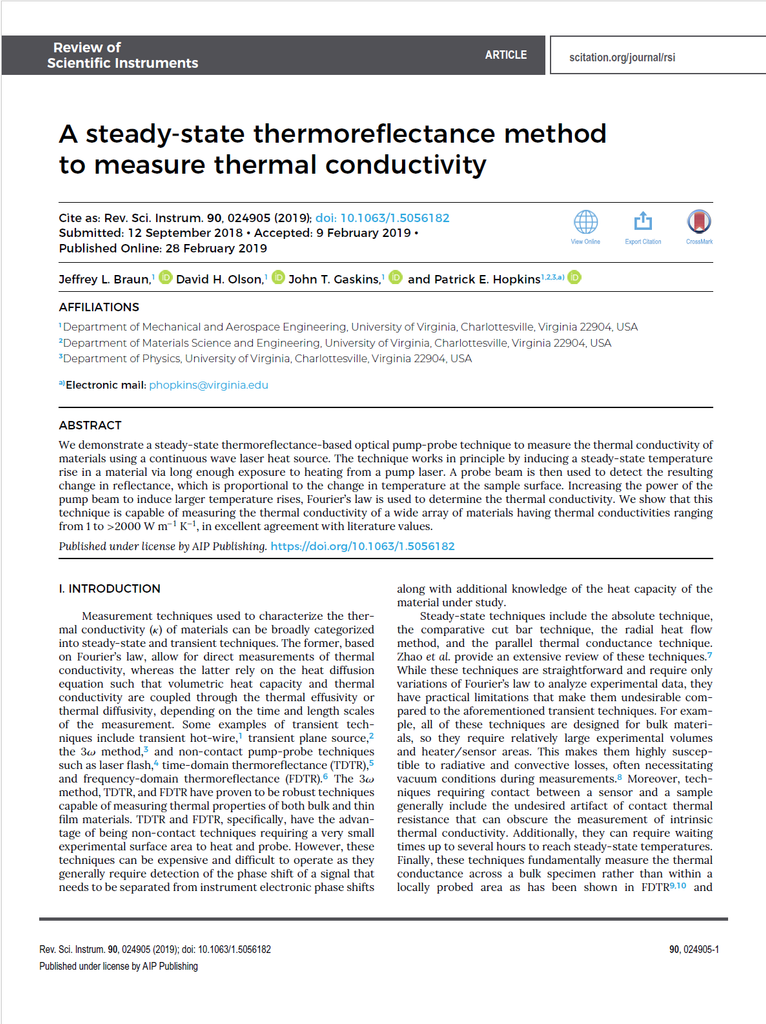
Engineers measuring thermal conductivity have had to choose between two imperfect options. Steady-state methods measure directly via Fourier’s law but need bulk samples, large heater and sensor areas, vacuum to limit losses, physical contact, and hours to reach steady state. Transient methods such as TDTR, FDTR and 3ω are fast and local but need phase separation and prior knowledge of heat capacity. This paper set out to combine the strengths of both.
The method
Steady-state thermoreflectance (SSTR) heats the sample with a modulated continuous-wave pump laser, and a low-power probe laser reads the surface temperature rise through an 80 nm aluminum transducer film. As pump power increases, the change in probe reflectance tracks the change in heat flux, and Fourier’s law then gives thermal conductivity from the slope. A sapphire wafer sets the calibration.
What the research showed
The team validated SSTR on materials from glass to diamond:
| Material | SSTR (W/m*K) | Literature (W/m*K) |
| Amorphous SiO₂ | 1.13 ± 0.08 | 1.3 |
| Z-cut quartz | 8.63 ± 0.36 | 8.6 |
| Sapphire (Al₂O₃) | 35.0 ± 1.4 | 34 |
| Silicon | 133 ± 6 | 133 |
| 4H-SiC | 310 ± 23 | 364 |
| Diamond | 1760 ± 390 | 1900 |
Values are from the paper’s PWA measurements. The measurable range spans about 1 to more than 2000 W/m·K.
Why it matters for your samples
- No heat capacity input is needed, and penetration depth is set by the pump radius, so results are less affected by the transducer and interface resistances.
- Each scan takes about 10 seconds to 5 minutes, without contact.
- Thin films under 100 nm can be measured in favorable cases, depending on the contrast between film and substrate conductivity.
- High-conductivity samples need more care: for diamond, results were highly sensitive to thermal boundary conductance, so two spot sizes were needed to fit both values.
From paper to platform
SSTR is now one of the two measurement modes in FASTR, which pairs it with FDTR. The 2019 setup took seconds to minutes per scan. FASTR’s SSTR mode runs a test cycle in under 1 second.
Citation
Jeffrey L. Braun, David H. Olson, John T. Gaskins, and Patrick E. Hopkins, “A steady-state thermoreflectance method to measure thermal conductivity,” Review of Scientific Instruments 90, 024905 (2019). DOI: 10.1063/1.5056182.