Thermal conductivity measurements
of sub-surface buried substrates
by steady-state thermoreflectance
Research summary · How SSTR measures substrates and layers buried under thin films, where TDTR and FDTR struggle to reach
The problem
In real devices, the layer that limits heat flow is often not at the surface. It sits under an epitaxial film, an oxide or a stack of coatings. Time- and frequency-domain thermoreflectance (TDTR and FDTR) typically probe only about 0.2 to 3 µm below the surface, so a substrate buried under a 2 µm GaN film is mostly out of reach. The 3ω method can go deeper but needs a large, flat surface, microfabricated heater lines and careful preparation, which is especially difficult for conducting and semiconducting samples.
The approach
The team studied how deep steady-state thermoreflectance (SSTR) can actually measure, both in simulation and experimentally. SSTR heats the sample with a low-frequency modulated continuous-wave laser long enough to reach steady state, so the heat reaches much deeper than in transient methods. It needs only an optically smooth area of about 100 × 100 µm² or less.
What the research showed
- Penetration depth is an estimate, not a limit. The usual definition (the depth where temperature falls to 1/e of the surface value) underestimates SSTR. Measurements remained possible beyond both that depth and the laser spot radius.
- Uncertainty depends on the whole stack. How well a buried layer can be measured depends on the transducer, the interface conductances and the resistance of the layers above it, not on depth alone. The authors recommend running sensitivity calculations before measuring.
- Larger spots reduce uncertainty. Increasing the pump and probe radii from 10 to 20 µm reduced uncertainty in every case:
| Buried substrate | Film above it | SSTR, 10 µm spot | SSTR, 20 µm spot | TDTR at 1 MHz | Literature |
| Silicon | ~130 nm SiO₂ | 141± 27 | 140 ± 18 | 132 ± 32 | 140 |
| GaN | ~2.05 µm GaN | 194 ± 27 | 185 ± 16 | 213 ± 60 | 195 |
| Sapphire | ~2 µm AlN | 35.1 ± 5.9 | 34.5 ± 4.2 | 36.4 ± 13.5 | 35 |
Thermal conductivity in W/m·K. TDTR was run at 1 MHz, below its typical 8 to 10 MHz, to reach the substrates.
- Buried films can be measured, under one condition. A layer in the middle of a stack can be isolated when its thermal resistance is much higher than the layers around it. Using 20 µm spots, the team measured a 1 µm SiO₂ layer buried under 2.5 µm of silicon at 1.34 ± 0.26 W/m·K, consistent with the literature.
Limitations the authors note
- A very resistive interface between film and substrate (about 200 m²K/GW or more) reduces sensitivity to the substrate, although SSTR then becomes sensitive to the interface itself.
- A conductive buried film can’t be isolated.
- A poor transducer-to-film interface pulls sensitivity away from the layers below.
What it means for your samples
| If you need to know… | This paper shows… |
| Substrate conductivity under a GaN, AlN or oxide film | SSTR measures it with lower uncertainty than TDTR |
| Whether your buried layer is measurable at all | Sensitivity calculations answer that before testing |
| The conductivity of a resistive buried layer | It can be isolated with larger spot sizes |
From paper to platform
SSTR is one of FASTR’s two measurement modes, and FASTR isolates depth-dependent behavior up to a maximum penetration depth of 10 µm.
Citation
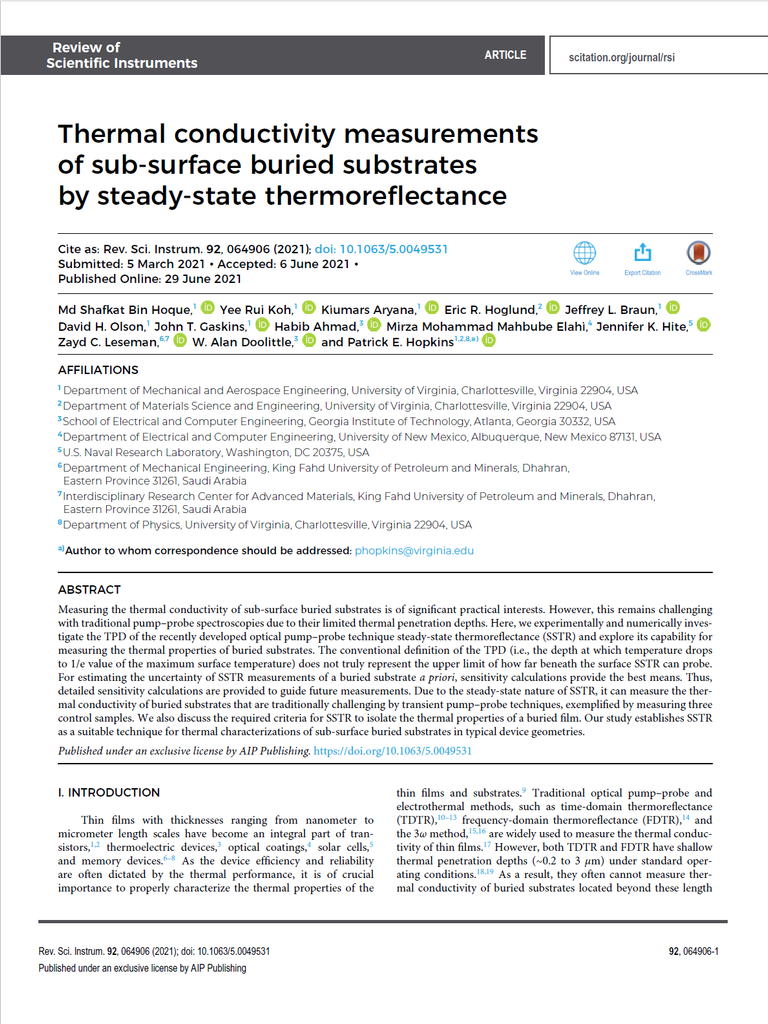
Md Shafkat Bin Hoque, Yee Rui Koh, Kiumars Aryana, Eric R. Hoglund, Jeffrey L. Braun, David H. Olson, John T. Gaskins, Habib Ahmad, Mirza Mohammad Mahbube Elahi, Jennifer K. Hite, Zayd C. Leseman, W. Alan Doolittle, and Patrick E. Hopkins, “Thermal conductivity measurements of sub-surface buried substrates by steady-state thermoreflectance,” Review of Scientific Instruments 92, 064906 (2021). DOI: 10.1063/5.0049531.