Measurements of thermal transport properties of materials (e.g., thermal conductivity, thermal diffusivity) rely on being able to measure the temperature changes along a thermal gradient, which is induced from an applied heat flux. Thus, thermal transport metrologies typically rely on the following procedure: 1) apply heat flux (Q) to a material inducing a temperature gradient; 2) measure change in temperature change (ΔT) at some (or several) points in space and time of this temperature gradient that was induced by Q; 3) relate measured ΔT as a function of Q to heat equation to extract thermal conductivity and/or thermal diffusivity.
Traditional thermal conductivity measurement techniques apply heat sources or sensors (thermometers) via direct contact to a material. For example, techniques such as guarded hot plate place a heater to apply a well known heat flux in contact with the measurement specimen, and measure the temperature at various locations along the induced temperature gradient, thus providing ΔT as a function of Q. Commonly, these traditional thermal conductivity measurement techniques use heat sources or sensors (thermometers) that are often orders of magnitude larger than the thickness of the films that are ubiquitous in modern micro- and nanotechnologies. This means that the volume of material being measured using these techniques would be much greater than a coating or thin film, thus, the temperatures and temperature gradients being measured are dominated by everything but the thin film. Consequently, these techniques are not suitable to accurately measure the thermal conductivity of thin film materials.
With advances in lithography, these similar contact-based methods can be used to probe the thermal transport properties of micro- and nano-systems by careful patterning of metal lines that can be Joule heated to provide a known heat flux. The changes in electrical resistance of these metal lines can then be used to measure ΔT. These electrical resistance thermometry-based methods require the ability to carefully pattern metal heaters and sensors on well defined locations of a sample, since the measurement of thermal conductivity is directly related to how well known the applied heat fluxes are, and how precise the resultant ΔT is measured in space or time.
Non-contact, typically laser-based opto-thermal techniques offer the ability to apply a known heat flux and measure temperature changes without the need for intricate patterning of metal lines or advanced lithography techniques. The laser-based underpinning of these opto-thermal techniques allows for the heater geometry to be controlled based on the spot size of the laser source, thereby delivering a well known Q to the sample surface simply by changing the laser spot size. The resultant temperature changes induced from this ΔQ can then be measured via pyrometers, common in Laser Flash, or reflected lasers, often utilized in thermoreflectivity measurements.
Traditional implementations of Laser Flash involve the application of a pulsed laser to rapidly heat one side of a sample (i.e., a “flash” of energy to induce the applied heat flux), while the transient temperature change is measured on the other side of the sample. Thus, the principle of this measurement is to measure changes in temperature as a function of time on one side of the sample, while heat is being applied to the opposite side. This means that the measurement will be primarily dominated by the part of the material with the largest thermal resistance (corresponding to the largest temperature drop) through the thickness of the sample, making this approach in general non-applicable to thin films with thicknesses much less than the total sample thickness.
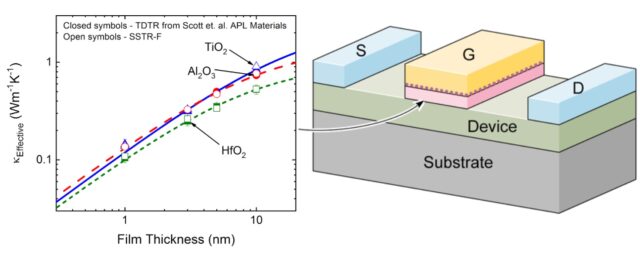
These concerns can be alleviated by thermoreflectance-based metrologies, such as time-domain, frequency-domain, and steady-state thermoreflectance (TDTR, FDTR, and SSTR, respectively). Immediately two major differences between these techniques and Laser Flash are identifiable: 1) Thermoreflectance techniques are laser-based “pump-probe techniques”,where one laser used to deliver the heat flux (pump) and the ΔT is determined from the changes in the second laser’s reflectivity (probe). 2) The pump and probe can be delivered on the same side of the sample via focused laser sources. This can vastly increase the sensitivity of the measurement of films and coatings on the surface of a material that are only fractions of the thickness of the entire submount. This is why thermoreflectance techniques have been ubiquitously used in the past few decades to measure the thermal transport properties of coatings, thin films, atomically thin interfaces, and even 2D materials.
It is important here to now make one final designation for all thermal transport property measurements techniques. Specifically, the different methods discussed above can be broadly grouped into two categories:
- Steady State: this method captures a measurement once the temperature gradient in a sample is constant in time. After heat is applied and a steady state temperature gradient is achieved after some time, the temperature gradient is measured and directly related to the thermal conductivity.
- Transient: measurements are taken as a function of time during or after a heating process, when the temperature at a point in space of a material is not constant, and hence, the temperature gradients are changing in time. These measurements can be taken using different transient heater and sensor designs such as a “hot wire,” “plane source,” or transient laser-based measurements such as laser flash.
In the various classes of techniques discussed above, transient techniques, such as Laser Flash, TDTR and FDTR rely on relating the measured changing temperatures to the transient heat equation, and thus by definition, the measured ΔTs are related to the thermal diffusivity of the sample or related to a property that is a function of both k and C. Thus, for these techniques, the heat capacity of the material being measured must be known to extract k.
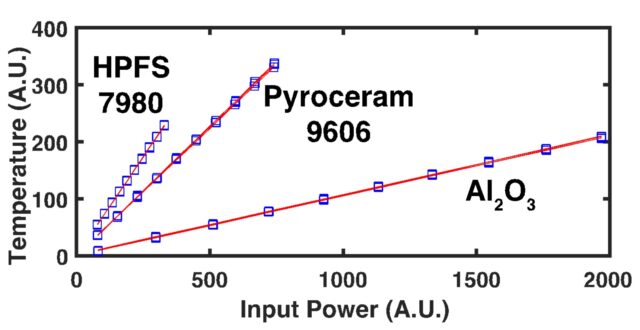
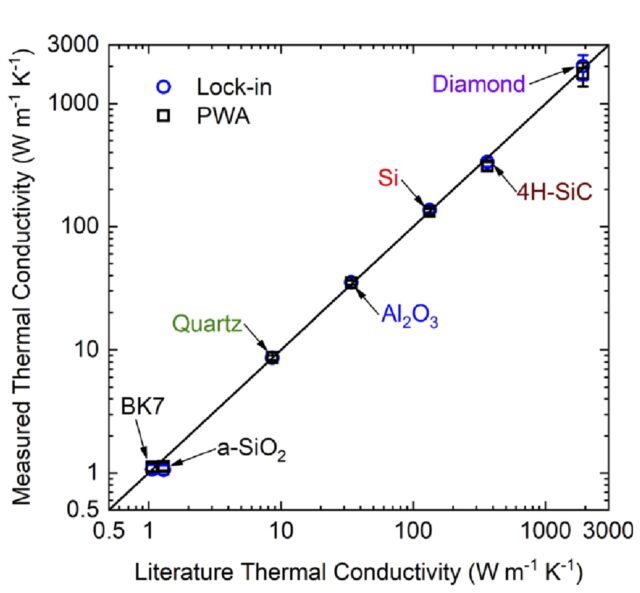
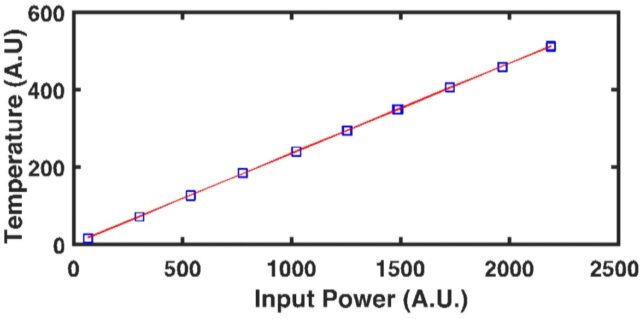
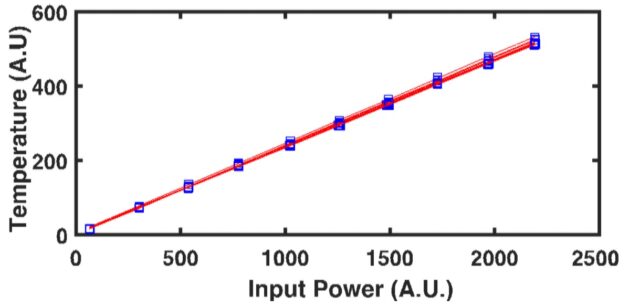
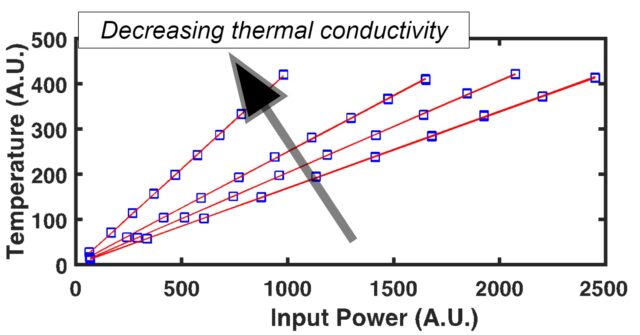
In steady state techniques, the measured ΔTs are related to the steady-state heat equation, which is the Fourier’s Law. In steady state, the temperature gradients have no dependency on the heat capacity of the sample, and thus steady state thermometry techniques, such as SSTR (used by FASTR), are a unique thermal transport metrology that can measure the thermal conductivity of a material. This benefit extends to thin film samples where the thermal conductivity can be measured directly, without having to infer the thermal conductivity from a measurement of thermal diffusivity.