
FASTR: The Direct Path to Complete
Thermal Characterization
Directional thermal conductivity, thermal boundary resistances,
volumetric heat capacity, and spatial mapping in
a single instrument.



- From nanometer-thin films to micron-scale features
- Wide thermal conductivity range (0.05 – 3000+ Wm-1 K-1)
- Full automation for unprecedented ease and measurements under a few seconds
- High fidelity data with <0.5% dynamic repeatability
Key Advantages of the FASTR Instrument
Engineers and researchers developing thin films and substrates engineered for thermal performance need to understand localized heat retention, dissipation, and interfacial resistance to optimize materials and layered systems. These properties often don’t behave as simulations or bulk data predict. Characterizing them has typically meant running separate setups, each adding time and a new source of variability. FASTR closes both gaps at once: one automated platform runs FDTR and SSTR on the actual thickness of the actual film.
 Confidence in real-world thermal behavior
- Captures thermal behavior of the actual film at its actual thickness, not a bulk proxy or a simulation input.
- Extends characterization down to sub-micron films, where bulk assumptions break down.
- Validates thermal models used in design and simulation.
- Supports in-plane, cross-plane, interfacial, and sub-surface configurations.
 Automation built for high throughput and consistency
- Spans acquisition, system alignment, and interpretation in one automated workflow, with no manual setup between samples.
- Includes a built-in reference sample, with every run computer-controlled and logged, removing manual calibration as a source of variability.
- Requires no optics expertise and no manual post-processing.
- Delivers results independent of who’s running the instrument, keeping pace with characterization requests instead of adding to the backlog.
 Results you can rely on, across material types and length scales
- Resolves lateral features down to 2 µm, and detects features as small as 100 nm.
- Isolates depth-dependent behavior up to a maximum penetration depth of 10 µm.
- Measures thermal conductivity across a range of 0.05–3000+ W m⁻¹K⁻¹.
- Supports characterization of anisotropic, layered, and heterogeneous materials.
 Mapping that locates what a single-point measurement misses
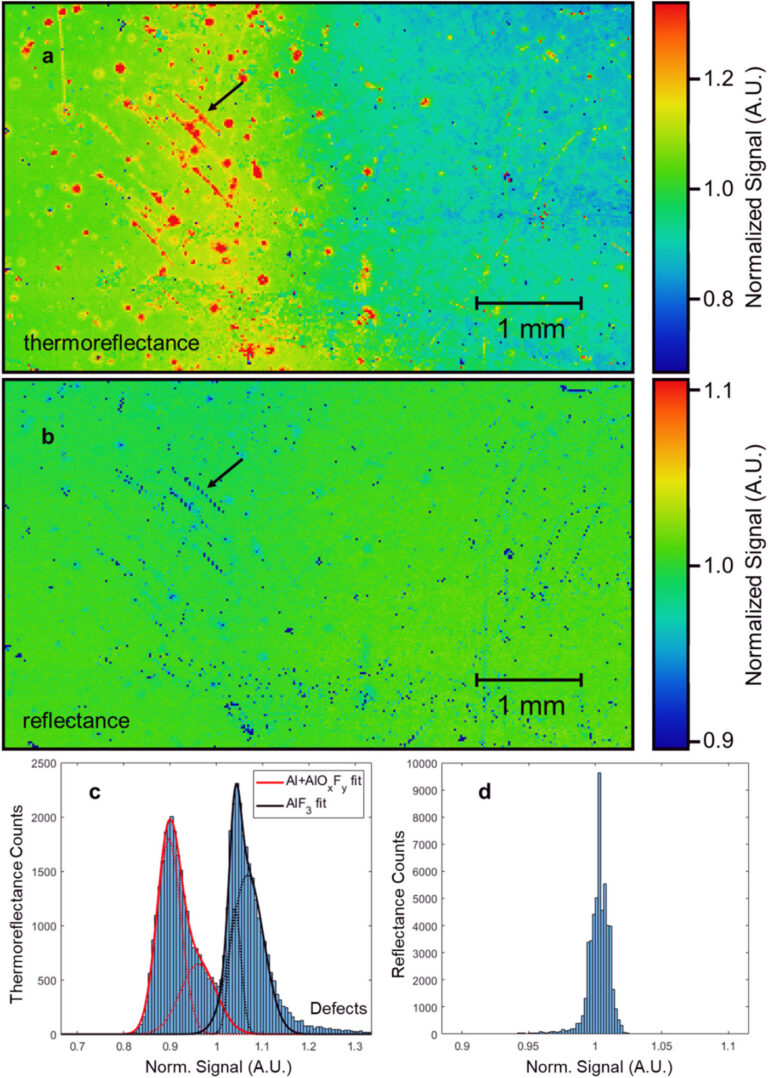
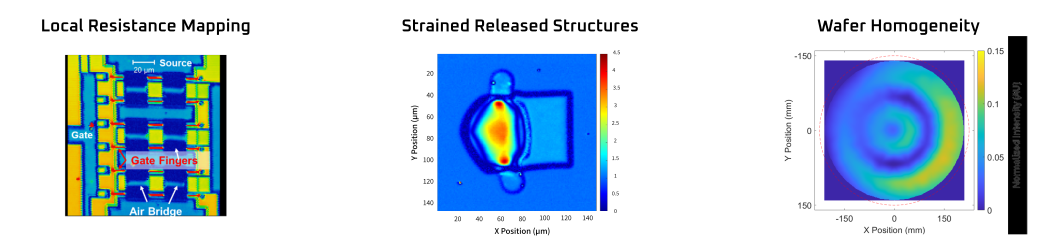
- Maps thermal properties across a sample to reveal local variation, inclusions, and process defects that a single-point measurement would average out and miss.
- Runs as an extension of the same automated measurement, so investigating a suspected defect doesn’t require new setup or sample prep.
- Scales from a single feature to a full 150 mm wafer without changing the setup.
Thermal Property Imaging
Highlights
FASTR is a thermal metrology instrument for characterizing multi-layer thin films, interfaces, and bulk materials at the length scales where thermal properties matter. It is the only instrument to run frequency-domain thermoreflectance (FDTR) and steady-state thermoreflectance (SSTR), with the same transducer, on a single automated platform. SSTR measures the total thermal resistance effective thermal conductivity of a stack directly, with no knowledge of volumetric heat capacity. FDTR partitions that same stack into individual films and interfaces, where the stack’s structure allows.
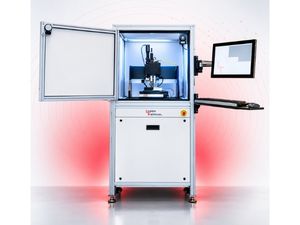
Conventional pump-probe systems rely on free-space optics, requiring careful alignment and exposed laser paths. FASTR integrates all active and passive optical components in a fully fiber-optic architecture instead, automating the alignment step and eliminating the exposed beam path.
FASTR measures directional thermal conductivity, thermal boundary resistances, and volumetric heat capacity. Measurements require minimal sample preparation, no prior optical expertise, and complete in as little as 1 second (SSTR mode) and under 90 seconds (FDTR). Its software suite automates system alignment, calibration, measurement, and multi-sample and multi-point testing – all computer controlled and logged, and with the reference sample built into the stage.

Specifications
| Thermal Conductivity | Thermal Boundary Resistances (TBR) | Volumetric Heat Capacity | Thermal Property Mapping |
|---|---|---|---|
| 0.05 – 3000+ Wm-1K-1 | >1 m2KGW-1 | 1 MJm-3K-1 to 4 MJm-3K-1 | 10×10 µm to 150×150 mm |
| Dynamic Repeatability | Test Cycle Time – SSTR | Test Cycle Time – FDTR | Test Cycle Time – Mapping |
|---|---|---|---|
| <0.5% | <1 second | <90 seconds | <20 milliseconds / pixel |
| XY Travel | Automation | Standard Objective Lenses |
|---|---|---|
| 150×150 mm | Fully automated testing | 10x and 20x, automated switching |
| Temperature Range | Minimum Laser Spot Size / Lateral Resolution | Maximum Thermal Penetration Depth |
|---|---|---|
| Room temperature. Up to 300 °C is an option | 2 µm (with feature detection down to 100 nm achievable under sufficient thermal contrast). | 10 µm |
| Smallest Detectable Lateral Feature | ||
|---|---|---|
| 100 nm |
| Sample Dimensions | Thickness Range | Sample Roughness |
|---|---|---|
| Coupons – 5×5 mm to 25×25 mm Wafers to 150 mm 150 × 150 mm region of a 300 mm wafer | Thermal resistance: ≥ 1 nm up to 300 nm* *material dependent Thermal conductivity: ≥ than 100 nm | <10 nm RMS |
| Dimensions | Weight | Power Requirements | Laser Safety |
|---|---|---|---|
| 31″W x 69″H x 32″D | 500 lbs (nominal, varies by options) | 110/220 VAC, 50/60 Hz, Power: 1 kW | Available as Class I or Class IIIb |
Downloads
Peer-reviewed technical papers
Title: A steady-state thermoreflectance method to measure thermal conductivity – Authors: Jeffrey L. Braun , David H. Olson , John T. Gaskins , and Patrick E. Hopkins – Publication: Review of Scientific Instruments. 90, 024905 (2019) – Link
Title: Spatially resolved thermoreflectance techniques for thermal conductivity measurements from the nanoscale to the mesoscale – Authors: David H. Olson , Jeffrey L. Braun , and Patrick E. Hopkins – Publication: Journal of Applied Physics. 126, 150901 (2019) – Link
Title: High In-Plane Thermal Conductivity of Aluminum Nitride Thin Films – Authors: Md Shafkat Bin Hoque et al – Publication: ACS Nano 2021,15,9588−9599 – Link
Title: Thermal conductivity measurements of sub-surface buried substrates by steady-state thermoreflectance – Authors: Md Shafkat Bin Hoque et al – Review of Scientific Instruments. 92, 064906 (2021) – Link
Title: High thermal conductivity and thermal boundary conductance of homoepitaxially grown gallium nitride (GaN) thin films – Authors: Yee Rui Koh et al – Publication: Physical Review Materials 5, 104604 (2021) – Link
Title: Unveiling Phonon Contributions to Thermal Conductivity and the Applicability of the Wiedemann—Franz Law in Ruthenium and Tungsten Thin Films – Authors: Md. Rafiqul Islam et al – Publication: Advanced Functional Materials 2025, e11592 – Link
Title: Characterization of AlF3-passivated aluminum mirrors using non-contact thermal metrology – Authors: Andrew H. Jones et al – Publication: Review of Scientific Instruments. 96, 024901 (2025) – Link
Videos
How it works
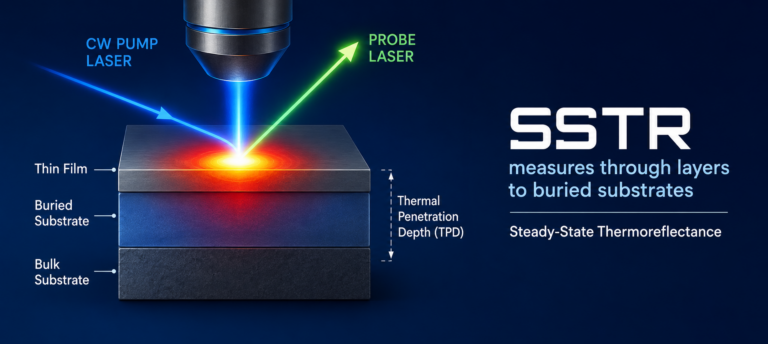
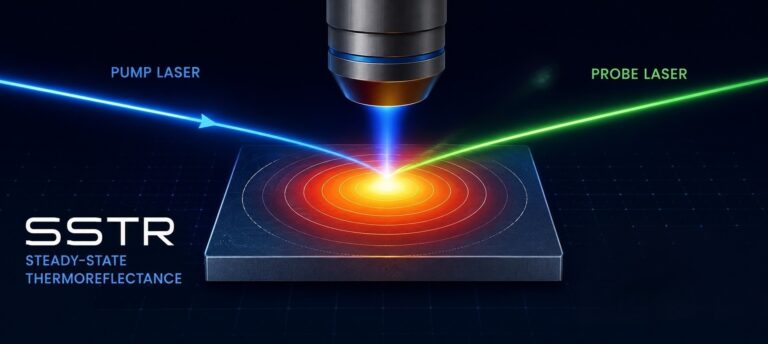
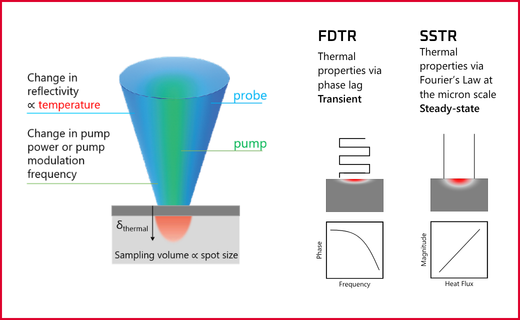
The instrument combines two complementary thermoreflectance techniques. A pump laser induces a small temperature rise at the sample surface through a thin metal transducer. A probe laser tracks the resulting temperature change through the fractional shift in surface reflectivity.
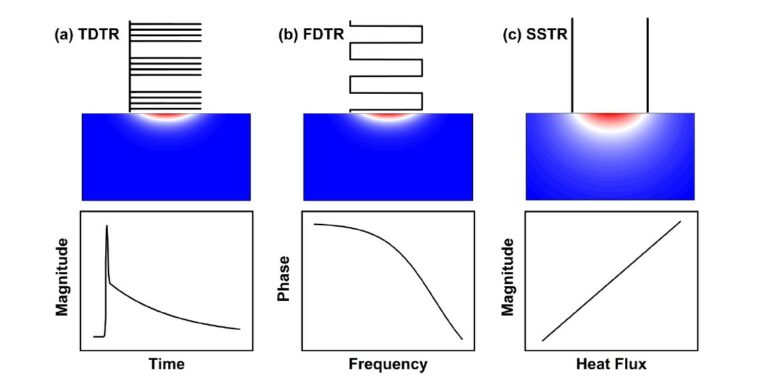
SSTR operates at steady-state and extracts thermal conductivity directly, without requiring knowledge of volumetric heat capacity.
FDTR modulates the pump periodically and sweeps the modulation frequency across several decades, measuring the phase lag between the heat input and the resulting temperature response. Because penetration depth shrinks as frequency increases, buried layers and interfaces leave their signature in different parts of the sweep. Fitting the resulting phase spectrum extracts cross-plane thermal conductivity, thermal boundary resistance, and volumetric heat capacity from a single measurement (depending on sensitivity).
Frequently Asked Questions
Measurement Capabilities
What does FASTR measure?
FASTR quantifies thermal conductivity (in-plane and cross-plane), thermal boundary resistance (TBR), and volumetric heat capacity. These properties are extracted through a hybrid integration of SSTR (steady-state thermoreflectance) and FDTR (frequency-domain thermoreflectance).
How does FASTR differ from TDTR?
FASTR and TDTR are both thermoreflectance techniques, but they handle a core limitation of transient thermoreflectance differently. In TDTR, thermal conductivity and volumetric heat capacity are correlated in the fit, so volumetric heat capacity is typically assumed from literature values. FASTR breaks that correlation. Its SSTR mode measures thermal conductivity at steady state, with no volumetric heat capacity in the analysis. With thermal conductivity fixed, FDTR can then resolve volumetric heat capacity on the same sample, so both properties are measured rather than one being assumed. FASTR also runs as a turnkey, fully automated platform in place of a manually aligned, expert-run setup.
Can FASTR characterize thin films and multilayers?
Yes. FASTR measures films from single nanometers to bulk: thermal resistance from 1 nm, and intrinsic thermal conductivity from 100 nm. In a multilayer stack, individual layers and interfaces can be resolved, as in our published work on AlN thin films. Whether each layer can be separated depends on the stack’s structure, the thickness of each layer, and the conductivity contrast between them; you should consult with our expert to discuss your samples and what can be measured. Where layers cannot be separated, FASTR reports the stack’s total thermal resistance and effective conductivity. Guided analysis shows how sensitive the measurement is to each fit parameter before a result is reported, so you know in advance which properties the data supports. For very thin films, a thickness series separates the film from its interface
What directional thermal conductivity information does FASTR provide?
FASTR can measure both cross-plane and in-plane thermal conductivity, depending on the sample configuration and measurement conditions.
Overall, FASTR’s directional thermal sensitivity is not fixed; it is determined by sample geometry, thickness, and substrate thermal properties, enabling flexible characterization of heat transport both parallel and perpendicular to the surface when the physics support it.
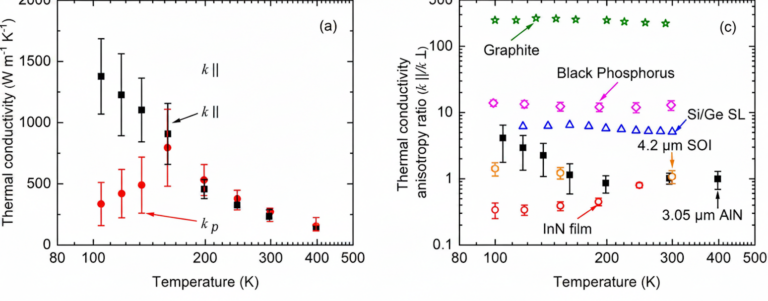
For example: it runs both modes sequentially for anisotropic materials like AlN: FDTR first for cross-plane conductivity and interface resistance, then SSTR for in-plane conductivity, giving the full directional picture that governs both heat extraction and lateral spreading in the actual device stack.
How is volumetric heat capacity determined?
FASTR determines volumetric heat capacity using its Frequency-Domain Thermoreflectance (FDTR) measurement mode. FDTR applies a sinusoidally modulated laser heat source to the sample and measures the resulting temperature response as a function of modulation frequency.
By fitting the frequency-dependent amplitude and phase data to a heat-diffusion model, SSTR mode fixes thermal conductivity with no heat capacity in the analysis. FDTR mode then resolves volumetric heat capacity and interface resistance against that anchored value.
Can you isolate thermal boundary resistance from bulk conductivity?
Yes, in most multilayer and bonded systems. As layers become thinner, thermal boundary resistance often dominates overall heat transport, which makes separating it from intrinsic layer conductivity both more important and more difficult. FASTR combines two modes to do this. FDTR sweeps the heating modulation frequency across several decades, changing the thermal penetration depth so the measurement becomes sensitive to different layers and interfaces at different frequencies. SSTR measures thermal conductivity independently, reducing the number of unknowns in the FDTR fit. Together, they resolve thermal boundary resistance within the stack rather than reporting a composite or “apparent” conductivity. For very thin layers, where a film and its interfaces respond as a single thermal resistance, a thickness series of samples may be needed to separate the two.
How do you handle high thermal conductivity materials?
Materials with high thermal conductivity generate small temperature rises, which reduces signal sensitivity in conventional bulk steady-state methods such as heat flow meters and guarded hot plates. For thin films, FASTR uses FDTR, adjusting modulation frequency to control heat penetration depth and concentrate sensitivity on the layer of interest.
Sample & Prep Requirements
What type of samples are compatible?
Compatible materials include: Thin films and coatings · Multilayer interfaces · High-k and low-k dielectric stacks · Wide bandgap semiconductors (AlN, GaN, SiC) · Metals, nitrides, and alloys · Semiconductor wafers.
What your samples need:
- A thin metal transducer, deposited in your own lab. Transducer quality drives data quality, so samples and references are coated under the same conditions.
- A known film thickness, from ellipsometry, X-ray reflectivity, or profilometry. Thickness enters the model directly.
- Film thickness: ≥1 nm for thermal resistance (up to 300 nm, material dependent), and ≥100 nm for thermal conductivity. For very thin films, a thickness series separates the film from its interfaces.
- Surface roughness below 10 nm RMS, for a continuous transducer and a clean probe reflection.
- Sample format: coupons 5 × 5 to 25 × 25 mm, wafers to 150 mm, or a 150 × 150 mm region of a 300 mm wafer.
Is a metal transducer required?
Yes. Most measurements require deposition of a thin metal film as a thermoreflectance transducer. This layer enables accurate detection of surface temperature changes via laser reflectance.
What are the stage limitations?
FASTR includes a motorized XY stage with 150 mm × 150 mm max travel, supporting wafers, dies, or sectioned device materials. Samples do not need to be precision-cut or rectangular; non-uniform or irregularly shaped coupons can be measured directly on the stage as long as they sit flat and fit within the stage travel.
What thickness limits apply?
Measurement limits depend on material properties and stack structure, not just thickness alone. Thin films below 10 µm, including bonded layers and thin bondlines, can be characterized when the measurement sensitivity is properly modeled. Unlike bulk steady-state methods that require large temperature gradients, advanced approaches are designed for thin geometries where traditional tools fail to resolve meaningful signals.
Workflow, Speed & Automation
What is the typical time per spot measurement?
Measurement time per spot depends on the FASTR measurement mode. SSTR measurements typically complete in under 1 second per location, while FDTR measurements generally take under 90 seconds per location, depending on the material and its thermal response. For thermal property imaging, it only takes 20 ms per pixel; the total measurement time scales linearly with the number of measurement spots.
Is batch testing supported?
Yes. The FASTR platform includes automated batch measurement protocols for up to 30 (5 mm x 5 mm to 25 x 25 mm) pre-positioned samples, improving throughput in R&D or QC environments.
Can users program spot locations for mapping?
Yes. Mapping routines can be scripted via software to define X-Y grids, enabling thermal property mapping with micrometer-level control.
Is specialized optics expertise required?
No. FASTR is built for accessibility. It includes automated alignment, laser path optimization, and intuitive software, reducing user variability.
Repeatability & Validation
What is the repeatability for FASTR?
Dynamic repeatability is <0.5%.
How are results validated?
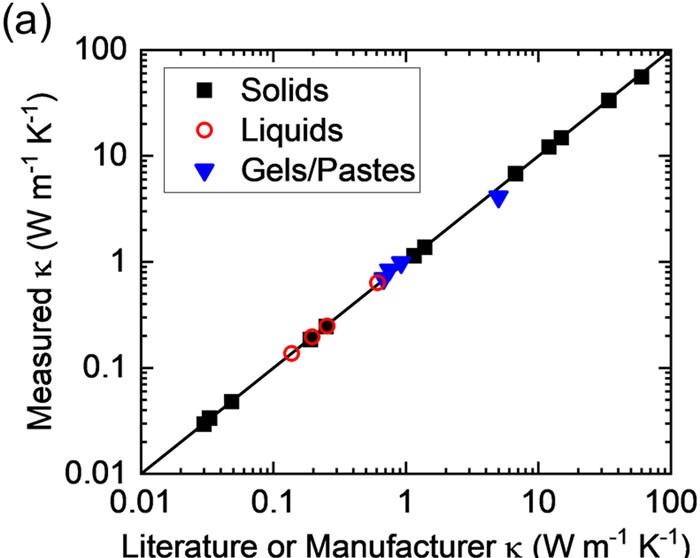
Results are checked against well-characterized reference materials (HPFS 7980 fused silica, thermal oxide on Si), with a reference sample built into the stage. The system is regularly used in blind sample validation, customer demos, and third-party verification. Please check this page as well to see our Thermal Conductivity Database for SSTR mode.
How does FASTR compare to Laser Flash Analysis (LFA)?
LFA measures thermal diffusivity on a bulk, homogeneous sample, then combines it with separately measured density and specific heat to calculate thermal conductivity. It is a well-established method for thick, uniform materials. FASTR takes a different approach suited to layered samples. Its SSTR mode measures thermal conductivity from the steady-state relationship between absorbed laser power and surface temperature rise, and FDTR then resolves thermal boundary resistance and volumetric heat capacity through model fitting. The analysis requires film thickness and substrate thermal conductivity, inputs that are routinely characterized in thin film work. It does not require density or specific heat of the film itself, which are difficult to obtain for thin films, and it does not require a bulk-equivalent sample. For bulk, homogeneous materials, LFA remains a proven method. For thin films, multilayer stacks, and buried interfaces, where LFA’s bulk assumptions no longer hold, FASTR is designed for that territory.
Use Cases & Applications
What kind of research or development workflows benefit from FASTR?
It supports workflows in:
- Semiconductor packaging
- Thin films
- Nanoengineered coatings
- Power electronics
- Low-dimensional or anisotropic materials
Can it be integrated with process development or material screening?
Yes. FASTR enables high-throughput testing, making it suitable for formulation screening, layer stack optimization, or interface engineering.
Is FASTR suitable for academic and industrial use?
Yes. The system is deployed in university labs, national labs, and industrial R&D teams, particularly those working on thermal metrology, device reliability, and novel materials.
What’s the learning curve?
Low. Most users are able to begin productive testing after minimal training. The software includes guided procedures for calibration, alignment, and data analysis.