
What is Thermoreflectance?
By Dr. Patrick Hopkins
Thermoreflectance as a tool to extract thermal properties
Over the past few decades, modulated thermoreflectance techniques have been used as a tool to back out the thermal properties of materials based on measurements of the thermoreflectance change on the surface of a sample. In commonly employed configurations of pump-probe thermoreflectance experiments, a pump beam is used to thermally excite the surface of the sample at some frequency, f. This leads to a change in temperature of the material, and since the optical properties of materials are related to temperature, the change in the optical properties of the material due to this modulated temperature change from the pump can be used as a probe of thermal properties. In practice, the change in the intensity of a reflected probe beam is related to the temperature change on the surface.
TDTR, FDTR and SSTR
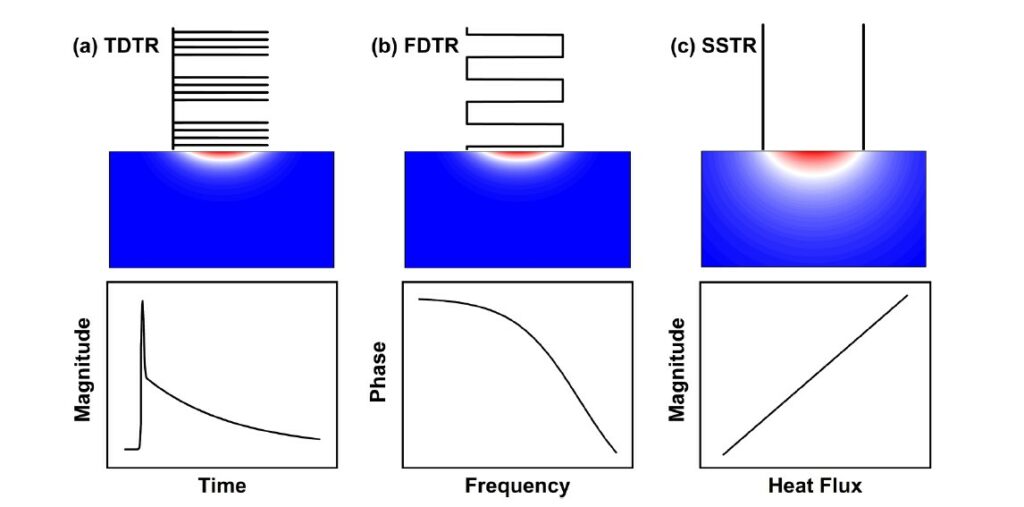
In a typical modulated pump-probe thermoreflectance experiment such time- or frequency-domain thermoreflectance (TDTR or FDTR, respectively), the change in the intensity of the reflected probe beam is related to the temperature change on the surface as a function of either frequency of the pump (in FDTR) or the delay time between the pump and probe pulses in the case of short pulsed-based experiments such as TDTR.
TDTR utilizes short, typically subpicosecond, pulses to monitor the thermoreflectance decay as a function of time after pump pulse heating event. FDTR uses either pulsed or continuous wave (cw) lasers to monitor the thermal phase shift in thermoreflectance signal as a function of f. A third technique, Steady-State Thermoreflectance (SSTR), has recently emerged, which monitors the thermoreflectance of the surface at increasing pump powers and induces a Fourier-like response in a material. Ultimately, SSTR offers a direct measure of the thermal conductivity of materials via optical pump-probe metrologies, whereas the transient nature of the temperature measurement in FDTR and TDTR results in these techniques measuring a combination of both thermal conductivity and heat capacity of the material. The characteristic pump excitations and responses for each of these techniques are presented in the figure below.
Spatially resolved surface measurements of thermal properties
In addition to their noncontact nature, these localized optical metrologies are advantageous relative to many other thermometry platforms since TDTR, FDTR and SSTR can probe relatively small volumes and near-surface regions. The thermal penetration depth (i.e., the depth beneath the surface in which these techniques measure the thermal properties), δthermal, can be limited to the focused spot size, or much less, depending on the modulation frequency. Furthermore, given that the pump and probe spot sizes can be readily focused to length scales on the order of micrometers, thermoreflectance techniques allow for spatially resolved surface measurements of thermal properties with micrometer-resolution and the ability to create 2D and even 3D, in the case of SSTR, thermal property “maps” or “images.”
Contact us to learn more about our instruments and services
We look forward to collaborating with you to understand your specific needs and provide tailored solutions for your project’s success.