
Thermal Conductivity
By Dr. Patrick Hopkins
Thermal conductivity, k, is the quantity that relates the heat flux through a material, Q, to the temperature gradient established across a material, dT/dx:
Q = -k dT/dx
This equation, known as “The Fourier Law”, predicts the temperature difference across some thickness of material in a steady state condition when the temperature is not varying in time. So, if you want to make sure your hand does not get too hot when you are holding your cup of coffee, you can either:
- Make the walls of the coffee cup thicker to make sure your hand is further away from the hot coffee (maybe put a handle on the mug, spacing your hand away from the heat source).
- Make the walls of the coffee cup out of a lower thermal conductivity material (maybe use a coffee sleeve which is made from porous materials with air pockets, making for very low thermal conductivity walls!).
In the International System of Units, thermal conductivity is expressed using W/m/K (Watts per meter-Kelvin).
A Sense of Scale
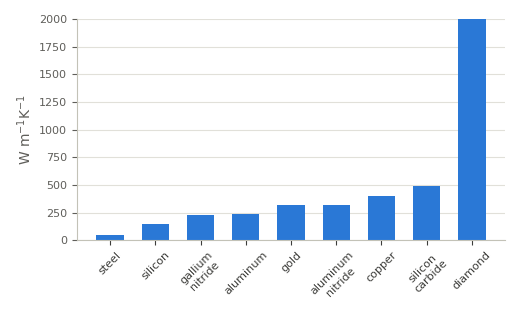
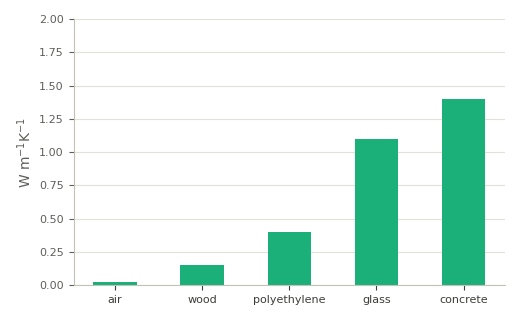
Thermal conductivity values span several orders of magnitude across common material classes. Diamond, one of the highest thermal conductivity materials known, exceeds 2000 W/m/K. Metals such as copper and aluminum fall in the range of 150 to 400 W/m/K. Many ceramics and semiconductors, such as silicon, sit between 1 and 150 W/m/K depending on crystal quality and doping. Glasses and most polymers fall between 0.1 and 2 W/m/K. Air, and porous or foam-like materials that trap air, fall below 0.1 W/m/K. This range explains why material selection alone, before any change in thickness, can shift the temperature rise across a component by more than an order of magnitude.
Examples of Conducting Materials
(above 20 Wm-1K-1)
Examples of Insulating Materials
(below 2 Wm-1K-1)
Directional Dependence
Thermal conductivity is not always the same in every direction through a material. In materials with layered or crystalline structure, heat can travel more easily along one axis than another. This directional dependence is called anisotropy. A single reported value for k may not describe how a material behaves in a real device, where heat often needs to move in a specific direction, such as through the plane of a thin film or across a stack of layers. Materials with strong in-plane and cross-plane differences require measurement approaches sensitive to direction, since a bulk or averaged value can miss the resistance that actually limits heat flow in the device.
Thermal Conductivity vs. Thermal Diffusivity
Thermal conductivity, k, and thermal diffusivity, sometimes denoted α, are related but distinct properties. Thermal conductivity relates heat flux to a temperature gradient under steady-state conditions, as described above. Thermal diffusivity describes how quickly a temperature change propagates through a material over time, and depends on thermal conductivity, density, and heat capacity. The two properties are related by:
α = k / (ρ Cp)
where ρ is density and Cp is specific heat capacity. Measurement techniques that rely on a changing temperature over time, such as transient methods, measure thermal diffusivity directly and require heat capacity to extract thermal conductivity. Steady-state techniques measure thermal conductivity directly, without depending on heat capacity.
Connecting Back to Thermal Resistance
Thermal conductivity is the material property that determines the thermal resistance of a layer of known thickness, following Rth = d/k. A lower thermal conductivity, or a thicker layer, produces greater resistance to heat flow, and greater resistance to heat flow means a larger temperature difference across that layer for the same applied heat flux. This is why thermal conductivity values feed directly into the resistance network used to trace temperature rise from a heat source through a device to the ambient surroundings.