https://laserthermal.com/wp-content/uploads/2025/10/TOPS_LT_WhiteBack-640x266.jpg

Thermo-Optical Plane Source

TOPS - Thermal Conductivity Instrument

Get fast, accurate, and repeatable thermal conductivity measurements.
Say goodbye to slow, complex prep and testing.

TOPS Isn't Just a Testing Tool. It’s a Game-Changer for Research, Development, and Manufacturing.

Accelerate Innovation & Win More Customers

Release better products (optimize properties, reduce risks of failures, and deliver more value) with the assistance of high-throughput, rapid thermal conductivity measurements for faster material discovery and product development.

Ensure Consistency & Build Confidence

Achieve dependable, repeatable measurements that validate material performance and manufacturing consistency so you will reduce uncertainty, accelerate qualification, and strengthen customer confidence.

Extend Precision to the Microscale

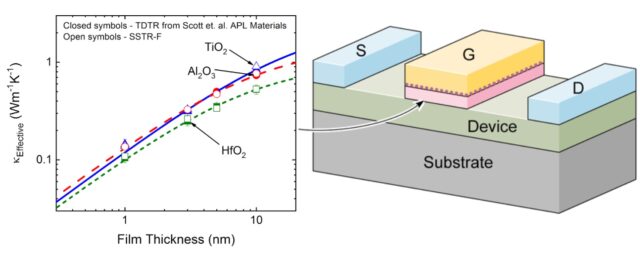
By accurately measuring thermal conductivity in films as thin as 20 microns, TOPS bridges the gap between bulk and microscale testing and supports next-generation materials development.

The Future of Thermal Conductivity Testing with TOPS

The TOPS system is a non-contact, steady-state thermal metrology tool that uses laser-based heating and infrared thermography to directly measure thermal conductivity across a wide range of materials including solids, foams, liquids, gels, pastes, glasses and ceramics.

By delivering localized heating and capturing temperature response with a high-resolution IR camera, TOPS provides fast, spatially resolved conductivity measurements with minimal sample preparation. It requires no knowledge of density or heat capacity and accommodates irregular shapes and production-ready parts. From insulating polymers to thermally conductive composites, TOPS simplifies thermal characterization with unmatched versatility, speed, and ease of use.

Unmatched Simplicity

TOPS directly measures the thermal conductivity of your material, eliminating the need to make assumptions about your materials specific heat capacity or density —one of the biggest limitations of transient methods.

Conventional techniques also require extensive sample preparation, often forcing you to shape materials to fit the instrument, making it impossible to test production-ready parts.

TOPS eliminates the need for extensive sample preparation, multiple test phases, complex calculations, or material property assumptions. Simply apply an emissivity film and insert your sample whether in bulk or a specific shape.

Record Time Testing

TOPS dramatically shortens testing cycles compared to traditional methods by utilizing laser heating and infrared thermography for a non-contact, single-sided measurement. Unlike conventional techniques that require heat to pass through the entire material, TOPS provides direct, steady-state thermal conductivity measurements in record time delivering insights in ~ 10 to 180 seconds.

Unsurpassed Versatility

TOPS offers outstanding versatility, analyzing a wide range of materials and geometries across industries. It can measure samples of nearly any shape or size with minimal restrictions, enabling precise, flexible testing.

With an approximately 1 mm laser spot size and fast thermal imaging, TOPS delivers thermal data in minutes. It’s ideal for heterogeneous or non-uniform materials where global averages miss critical variations. Mapping thermal conductivity across a surface and detecting local variation is essential for researchers developing composites, foams, or filled materials where uniformity impacts performance. With ±5% uncertainty and ±1% repeatability, its steady-state methodology ensures confidence in absolute thermal conductivity, especially in low-k regimes (<2 Wm-1K-1) where transient methods often fall short.

TOPS is designed for ease of use, featuring a compact, plug-and-play setup, a Class I laser for safety, and fully automated operation and data analysis. Training takes just a few hours and can be done remotely; no advanced engineering or thermal expertise required.

TOPS Specifications

Performance Specifications

Thermal conductivity range: ~0.01 – 100 Wm-1K-1
Temp range: room temperature
Test cycle time: ~10 – 180 seconds
Uncertainty: +/- 5%
Repeatability: +/- 1%
Laser spot: ~1 mm in diameter
XYZ travel: 150 mm (X) x 150 mm (Y) x 100 mm (Z)

Sample Requirements

Sample roughness: Surface roughness <1 μm rms (120 grit)
Thickness / Height: Thin films and coatings: > 20 μm / Bulk materials: 2 mm – 50 mm
Lateral area: Min: 2 mm x 2 mm / Max: 304 mm x 304 mm
Minimum Volume: Pates and gels: 22 cc/ml / Liquids: 50 cc/ml

Instrument Specifications

Dimensions: 24.75″W x 31.25″H x 28.5″D
Weight: 150 Lbs.
Power requirements: 110/220 VAC, 50/60 Hz, 15 Amp power outlet

TOPS: Frequently Asked Questions

FAQ: What TOPS Measures

Does TOPS measure intrinsic thermal conductivity?

TOPS measures thermal conductivity directly using steady-state heat flow and spatial temperature mapping.

  • For homogeneous materials, the measured value approaches intrinsic thermal conductivity.
  • For heterogeneous or composite materials, TOPS reports a physically meaningful effective conductivity that reflects internal heat transport without interface domination.
Why is direct thermal conductivity measurement important for TIM development?

Modern TIMs are engineered composites with fillers, networks, and microstructures that strongly influence heat flow. During development, engineers need to understand how heat moves within the material itself, independent of surface contact conditions.
TOPS, unlike other techniques, removes sensitivities to interfaces and pressure; thus enabling faster and more reliable iteration during R&D.

Can TOPS be used for materials that are difficult to test using other conventional methods?

Yes. TOPS is well suited for materials that are challenging for fixture-based methods, including:

  • Soft or highly compliant TIMs
  • Liquids, pastes, and gels
  • Materials with non-uniform thickness
  • Samples where contact pressure is difficult to control

Minimal sample preparation is required.

FAQ: Measurement Physics and Modeling

What spatial resolution does TOPS achieve?

The infrared camera pixel resolution is on the order of tens of microns. The effective measurement volume is defined by the laser heating spot, which is approximately 1 mm in diameter.
Thermal conductivity is extracted by averaging a region of interest near the center of the heating profile.

What type of thermal model does TOPS use?

TOPS uses a proprietary, embedded thermal model developed by Laser Thermal. The model is fully integrated into the system software and is designed specifically for steady-state, laser-based plane source measurements.
The underlying measurement physics, experimental setup, and data reduction approach are described in peer-reviewed publications, including Review of Scientific Instruments.

Is TOPS based on commercial simulation software?

No. The thermal model is not based on third-party commercial simulation tools. It is purpose-built for TOPS to ensure consistent, repeatable measurements and to avoid user-dependent modeling choices.

How does TOPS handle multilayer samples and substrates?

For multilayer measurements, such as thin films or primers on substrates, the thermal conductivity of the substrate is either measured independently or taken from reliable literature values and included as an input to the thermal model.
This allows the analysis to correctly account for heat flowing into the substrate when solving for the thermal properties of the thin layer.

Does TOPS require a bare or untreated reference sample?

This depends on sample thickness and thermal penetration depth:

  • If the sample is thick enough that heat does not reach the opposite surface, no separate reference is required.
  • If the sample is thin enough that the opposite side influences heat flow, a bare or untreated reference sample may be needed to characterize the substrate.

Laser Thermal evaluates this on a case-by-case basis.

Can TOPS measure in-plane and through-plane conductivity separately?

TOPS fundamentally measures the product of the in-plane and cross-plane thermal conductivities. In the current generation (Gen 1) TOPS system, these components cannot be separated for bulk materials. For film measurements, typically cross-plane thermal conductivity is being measured.

FAQ: Accuracy, Calibration, and Uncertainty

Do I need to know heat capacity or density?

No. TOPS operates in a steady-state regime and is insensitive to volumetric heat capacity. Thermal conductivity is measured directly without requiring density or heat capacity as inputs.

How is TOPS calibrated?

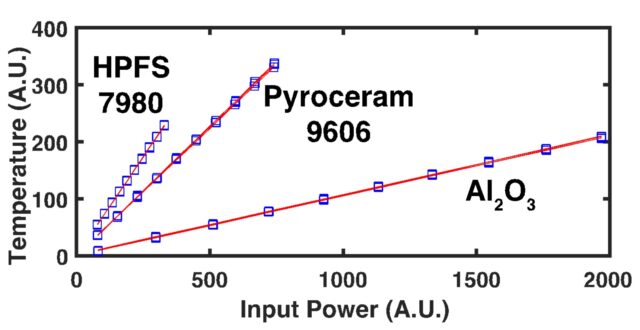
Each TOPS system is individually calibrated using well-characterized reference materials, including:

  • Single-crystal silicon
  • High-purity fused silica (Corning HPFS 7980)
  • NIST Standard Reference Material 1450e

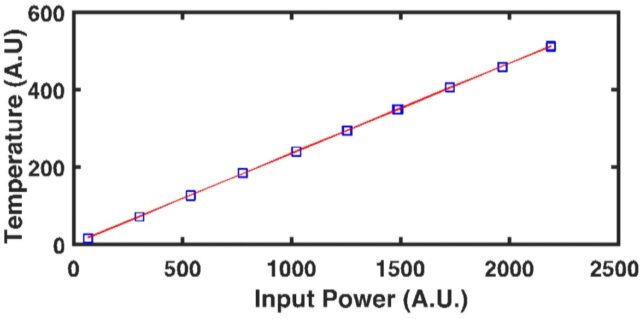
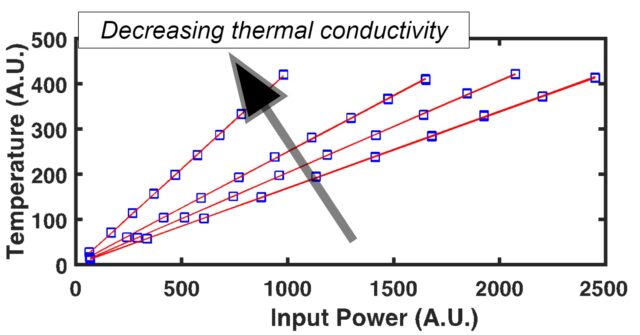
These references establish a calibration curve relating the measured temperature response to thermal conductivity.

Is the calibration linear across all conductivities?

At higher thermal conductivities (above approximately 0.1 W/m·K), the calibration relationship is linear.

At very low conductivities, non-linear behavior is accounted for due to heat exchange with the surrounding air.

How are heat losses such as convection or radiation handled?

The thermal model accounts for all relevant heat transfer pathways:

  • Laser energy is absorbed in the transducer layer, so reflection losses are negligible.
  • Heat spreading within the sample and substrate is included.
  • Convective and surface conduction losses are only significant for ultra-low conductivity materials, such as foams, and are explicitly modeled in those cases.

For most solids, coatings, and TIMs, these effects are minimal.

How does TOPS address uncertainty and repeatability?

TOPS measurements typically show:

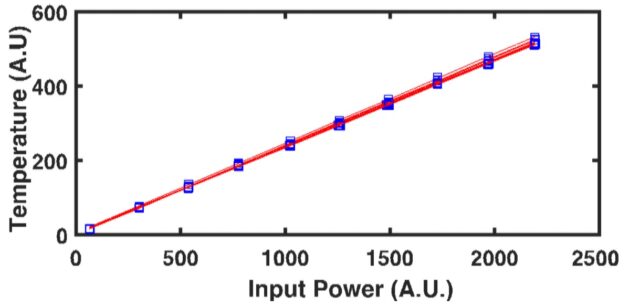
  • Spot-to-spot repeatability assessed across multiple locations
  • Same-spot repeatability below 1 percent under controlled conditions

Multiple measurements are performed and averaged to quantify variability and confidence.

Can TOPS results be validated against other methods?

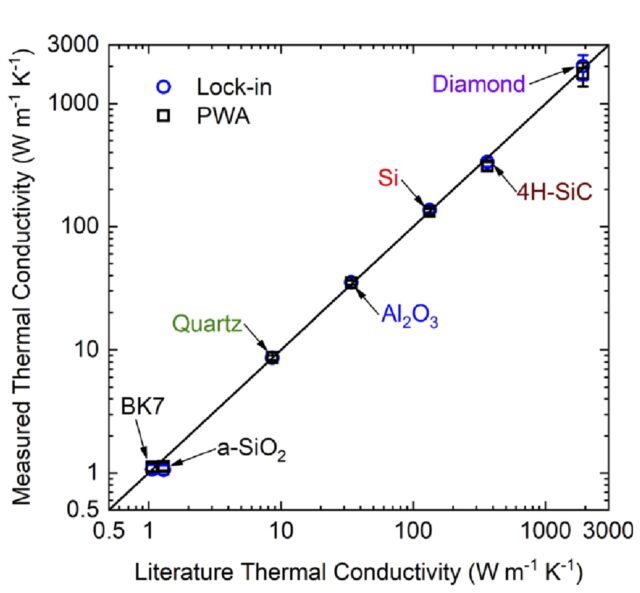
Yes. TOPS has been validated against:

  • NIST Standard Reference Materials
  • Guarded hot plate measurements for low-conductivity materials
  • Ongoing comparisons with laser flash and transient plane source methods for higher conductivity materials

Peer-reviewed publications describe the method, modeling, and validation in detail.

FAQ: Sample Requirements and Practical Use

Why does TOPS use a surface transducer layer?

TOPS uses a thin transducer layer, typically around 5 microns thick, to ensure known and uniform emissivity for accurate infrared temperature measurement.
The transducer consists of a polymer film with an integrated adhesive layer that conforms to the sample surface, ensuring consistent thermal contact.

How is good thermal contact ensured?

The adhesive layer conforms to surface roughness and irregularities. For best results, Laser Thermal recommends an RMS surface roughness below approximately 1 micron, depending on the expected thermal conductivity of the material.

What are the sample preparation requirements?

Sample surface finish should be better than approximately 1 micron RMS (about a 120-grit finish or finer). The emissivity film is adhesive-backed, supplied in pre-cut sizes, and can be applied and removed by hand.

Does sample color or ambient lighting affect the measurement?

No. Sample color does not affect the measurement because emissivity is controlled by the transducer layer. Measurements are performed in a closed system, so ambient lighting does not influence results.

What sample thicknesses can TOPS measure?

TOPS is well suited for:

  • Thin coatings and primers (micron-scale)
  • Thermal interface materials
  • Foams, polymers, and composites
  • Bulk materials where localized measurement is desired

If a thin layer dominates the total thermal resistance, substrate thickness is typically not a limiting factor.

How many samples or measurements are needed?

In many cases, a single test piece per material is sufficient. TOPS measures over a millimeter-scale area, allowing multiple independent measurements on the same sample.

Can TOPS measure liquids, pastes, and gels?

Yes. Laser Thermal provides dedicated containers for liquids and for pastes and gels. The emissivity film is applied across the container opening, and a small volume of material is loaded to contact the film.

Will the laser heating damage my sample?

No. The laser power used for measurement typically raises the sample surface temperature by approximately 5 K.

FAQ: Relationship to Standards and ASTM D5470

Is TOPS a replacement for ASTM D5470?

No. TOPS is not intended to replace ASTM D5470. It is designed to complement D5470 by providing information that D5470 does not capture.

ASTM D5470 measures thermal impedance and reports an apparent thermal conductivity that includes bulk conduction and interface effects under compression. TOPS measures thermal conductivity directly, without relying on contact interfaces or stack pressure. Together, they provide a more complete understanding of thermal behavior.

What information does TOPS provide that ASTM D5470 does not?

TOPS provides direct, steady-state measurement of thermal conductivity without the influence of mechanical interfaces. This allows users to:

  • Isolate bulk heat transport behavior
  • Evaluate formulation changes without interface artifacts
  • Detect spatial inhomogeneity or variability
  • Study materials that are difficult to fixture or compress consistently

This information is critical during material development and optimization, where small changes in formulation or structure matter.

What is the difference between ASTM D5470 and TOPS approaches?

ASTM D5470 addresses performance and answers the question: “How does this TIM perform in a specific stack under load?”. It does not explain behavior. TOPS explains behavior and answers: “Why does this material behave the way it does?”

Using TOPS early in development reduces trial-and-error, accelerates formulation optimization, and prevents promising materials from being overlooked due to interface-dominated measurements.

How are TOPS and ASTM D5470 typically used together?

In advanced TIM workflows, the methods are used sequentially:

  • TOPS is used during formulation and optimization to understand bulk thermal conductivity, uniformity, and sensitivity to composition.
  • ASTM D5470 is used later to evaluate pressure-dependent performance in realistic interfaces and to support qualification and datasheets.

This combination enables both innovation and standards compliance.

Is TOPS aligned with any international standards?

At present, there is no international standard that directly governs TOPS measurements. The technique was developed recently and has only been commercially available for a short time. Laser Thermal is actively pursuing standardization. In many cases, TOPS enables measurements that are not possible with existing standardized methods, particularly for thin coatings, primers, compliant materials, and non-ideal geometries.

Faster, Simpler, and More Versatile Thermal Testing